


Most ecommerce brands treat fulfillment as a cost center. Get the product out the door, keep the error rate low, move on. The unboxing moment, that brief window when a customer opens their order for the first time, gets almost no strategic attention. And that is a significant missed opportunity.
Drew Carpenter is the co-founder of Yuzu, a platform that turns the package insert into a measurable, personalized marketing channel. Drew spent years on warehouse floors, first fulfilling his own ecommerce orders out of his parents’ garage in the UK as a teenager, then joining a third-party logistics provider (3PL) during COVID where he watched hundreds of brands lose their ability to connect with customers at the most emotionally engaged moment in the purchase journey. He built Yuzu specifically because he saw a gap no one else was closing: brands wanted to deliver personal, relevant experiences inside every box, but the tools and infrastructure to do that at scale simply did not exist.
Welcome to episode #54 of The Ecommerce Revolution Podcast. Each week, we feature a guest who’s an expert in their field to share real strategies to help you launch, grow, and win in commerce. If you want support on your journey, join our community of hundreds of entrepreneurs and get access to content, coaching, workshops, and a private network of fellow ecommerce entrepreneurs.
Why the Unboxing Moment Has Been Ignored
When Drew was working at his first 3PL, he saw the same pattern repeat constantly. Smaller brands would join the network and immediately ask: can we include handwritten notes from the founder? Can we set up gift messaging? Can we add our brand font to the packing slip? The 3PL’s answer was almost always no, or at best, a clunky workaround. The warehouse management system (WMS) did not support it. The operations team could not guarantee consistency. The economics did not work.
The result was that brands handed over their fulfillment and lost the personal touch that had defined their customer relationships. Larger brands on the same network had the opposite problem: they never even considered it. Personalized unboxing was not in their mental model because no one had shown them it was possible.
That gap between what brands wanted to communicate and what the physical package actually delivered became the foundation for Yuzu.
What Yuzu Actually Does
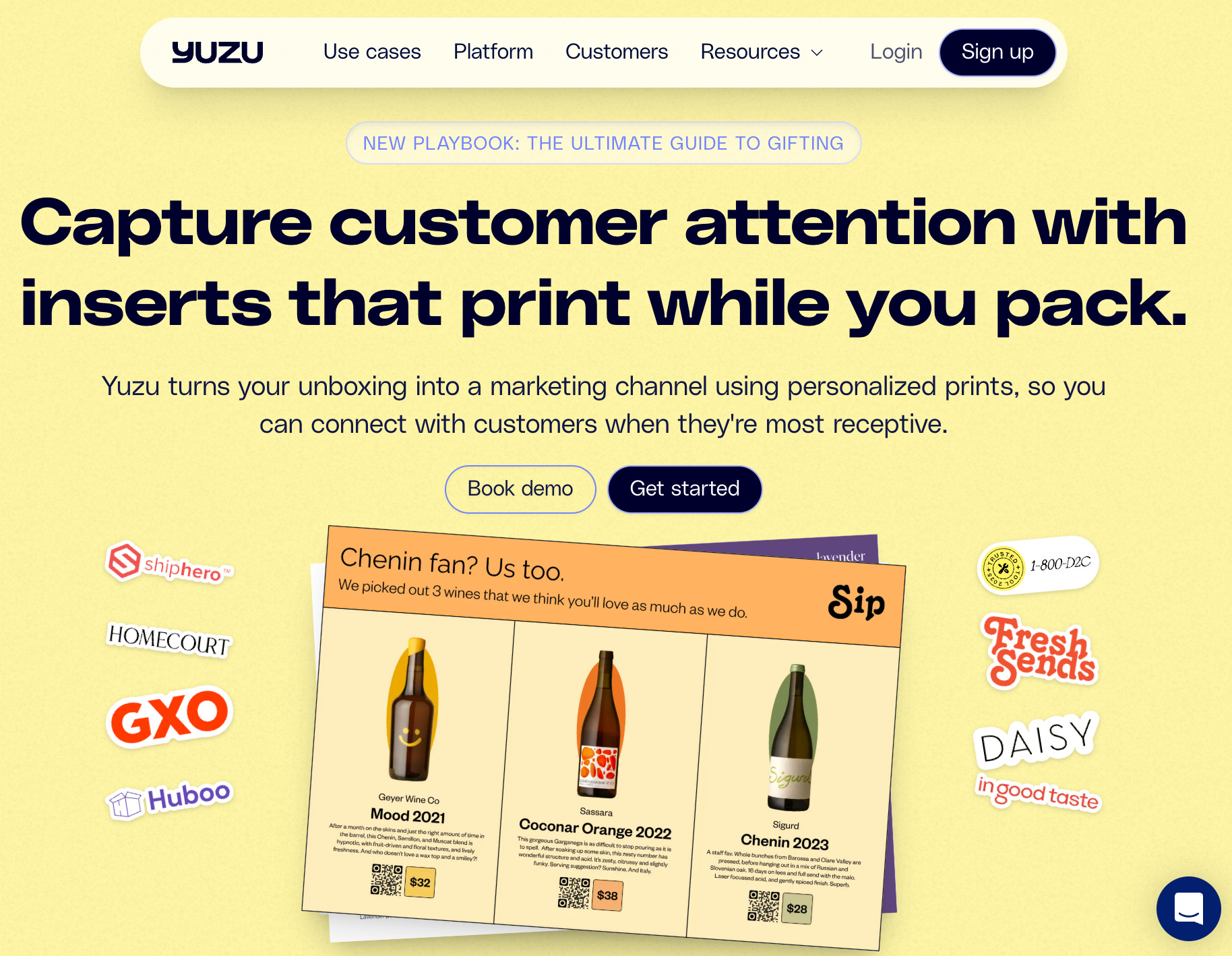
Yuzu enables brands to put personalized, data-driven inserts inside every order. Not the same static flyer for every customer. Each insert is built from what you actually know about that person. Their order history, their loyalty status, the specific products they purchased, how long they have been a subscriber, whether they are a first-time buyer or a VIP.
The mechanics work like this: a brand connects Yuzu to their Shopify store (and optionally to Klaviyo, a loyalty tool like LoyaltyLion, or a product recommendation engine like Rebuy). They design templates inside Yuzu’s flow builder, assign those templates to customer segments based on order count, lifetime value, or loyalty engagement, and then the platform produces a unique insert for each incoming order. That insert is printed on demand at the 3PL, triggered the same way a shipping label is, and included in the box without any manual coordination between the brand and the warehouse team.
The insight Drew keeps coming back to is a simple analogy: imagine running your email marketing channel but sending the exact same message to every subscriber, with no segmentation, no personalization, and no way to track whether anyone ever clicked anything. That is exactly what most brands are doing with package inserts today. Yuzu applies the logic of modern email marketing to the physical channel.
The Insert Strategies That Are Working Right Now
Drew and his team have identified a handful of insert approaches that consistently drive results. Here is what is working across their merchant base.
First-time customer inserts. The first-to-second purchase conversion is one of the highest-leverage actions in ecommerce retention. A first-time customer insert acknowledges the purchase, reinforces confidence in the brand, and creates a clear, relevant invitation to come back: a product recommendation, a loyalty program enrollment, or a well-timed discount. The physical insert lands at the exact moment the customer is holding your product for the first time. There is no better time to deepen the relationship.
VIP customer recognition. Your highest-value customers respond to being treated like it. A VIP insert that acknowledges their history with your brand, surfaces their loyalty points balance, and invites them into a referral or review program creates a tangible experience of being seen. This is also a high-conversion moment for referral programs. A VIP customer who just received something they love and an insert that makes them feel appreciated is primed to share.
Dynamic product upsells. For stores with a significant SKU count, Yuzu integrates with tools like Rebuy to generate personalized product recommendations on each insert. A customer who just bought a skincare starter kit gets a recommendation for the next logical product, specific to what they bought and not a generic “you might also like” message. This is product education and cross-sell working together in a format that is often more trusted than a follow-up email because it arrives with the product itself.
Retail launch campaigns. This one surprised me in the conversation. Brands that are expanding into retail locations can use Yuzu to include a personalized map in each order that shows the customer’s proximity to their nearest store. When a brand is launching into Walmart or a regional retail partner, a physical insert that tells a specific customer “there is a location 2.3 miles from your home” turns an announcement into a genuinely useful, localized call to action. Drew noted that this approach has produced real traction, especially at the moment of a new retail partnership launch.
Seasonal and lifecycle triggers. In the run-up to Black Friday and Cyber Monday, brands are using inserts to prime existing customers on upcoming offers, the same way you would use a pre-campaign email sequence. During the holiday gifting season, gift messaging becomes a core use case. Drew’s team is seeing brands use inserts to capture email and SMS opt-ins from gift recipients who are discovering the brand for the first time. That is a remarkably clean acquisition path: the gift recipient opens the box, finds a compelling insert, and subscribes before they have even decided whether they love the product.
Why Inserts Have a Measurement Problem, and How Yuzu Solves It
One of the most important things Drew said in this conversation was a direct challenge to brands who have tried inserts before and written them off: if you ordered a print run of 10,000 static inserts, put them in boxes, and never saw a meaningful return, you did not prove that inserts do not work. You proved that an untargeted, untracked, static campaign is hard to optimize. That is not an insight about the channel. It is an insight about the method.
Yuzu tracks QR code scan rates, dynamic discount code redemptions, and attribution back to specific insert variants. Brands can run A/B tests on insert designs, compare performance across customer segments, and make live edits to campaigns without coordinating a reprint or sending an email chain to the warehouse team. The insert changes in the platform, and the 3PL just prints whatever is right for the next order.
This shifts the insert from a print job into an optimizable channel, one that can be iterated on the same way a brand iterates on email subject lines or ad creative.
Who Should Be Using This (And When)
Drew was direct about where Yuzu fits in a brand’s growth trajectory. The platform is built for brands that have already nailed their digital marketing fundamentals. If your email flows are not working yet, if your SMS strategy is still being figured out, the insert channel is probably not your next move. But for brands in the Shopify Plus range that have their core retention channels dialed in and are looking for an additional touchpoint, the in-package insert is an underexplored lever.
That said, Drew made a point worth sitting with if you are earlier in the journey: if you are still fulfilling in-house and packing orders yourself, do not automate away the personal touch yet. Handwrite the notes. Call the customer after they receive their first order. The things that do not scale are often the most powerful tools available to a new brand precisely because they are rare. Use that window while you have it. When your volume forces you to outsource fulfillment, that is when a platform like Yuzu becomes the bridge between operational efficiency and the customer experience you were delivering by hand.
Choosing a 3PL: The Mistake Most Brands Make
Drew spent several years inside the 3PL world before building Yuzu, and he has one piece of advice for brands evaluating fulfillment partners that I think is genuinely undervalued: do not let price be the only decision variable.
He has seen the pattern too many times. A brand selects the cheapest option, runs into operational problems within six months, and ends up having to migrate their entire inventory and workflow twice in a year. The cost of that disruption almost always exceeds whatever they saved on per-order fulfillment fees. The quality of a 3PL’s WMS, their SLA on order fulfillment, their willingness to integrate with tools like Yuzu, and the experience they deliver at the unboxing stage all matter, and none of those show up in a price comparison.
Key Takeaways
Your package is a first-party channel you already own. Every order that ships is an impression delivered to a customer in their most engaged moment. Treating that moment as a logistical output rather than a marketing touchpoint is leaving a channel on the table.
Personalization is not just a first name. True personalization in the insert channel means tailoring the offer, the content, and the call to action based on order history, customer segment, and lifecycle stage. It is the same logic you apply to your email flows.
Track everything. Dynamic discount codes and QR scan rates give you attribution. Without measurement, you cannot optimize. Without optimization, the channel never improves. If you have tried inserts before without tracking, you have not actually tested the channel.
First-time and VIP workflows are the starting point. If you are going to try one insert strategy, start with a first-time customer flow. The first-to-second purchase conversion is where retention either starts or stalls. A well-constructed insert at that moment is one of the highest-leverage investments you can make in customer lifetime value (LTV).
The physical channel scales online logic. The most powerful frame Drew offered is this: everything you are already doing in email, SMS, and paid retargeting can be transposed into the physical package. The channel is different. The strategy is the same.
Do not move to a 3PL until you have maximized in-house personal touch. Early-stage brands that are still packing their own orders have an advantage: genuine, unscalable personal connection. Handwritten notes, follow-up calls, and one-to-one messages are more powerful than any automated insert at low order volumes. Use that window intentionally before you optimize it away.
Price is the wrong 3PL filter. Evaluate fulfillment partners on their technology stack, their SLA, and their willingness to support the customer experience you want to deliver. Cost per shipment is one factor, not the only one.
Connect with Drew and Yuzu
Website: www.yuzu.so
LinkedIn: Drew Carpenter (search Drewston Carpenter)
Email: dru@yuzu.so
The box leaving your warehouse right now is either a missed opportunity or a marketing asset. Drew and his team have built the infrastructure to make it the latter, and the conversation in this episode gives you the strategic context to decide whether the timing is right for your brand.
🚀 Join the E-Commerce Revolution at ecomrevolution.co for content and coaching to launch and grow your e-commerce business.


