


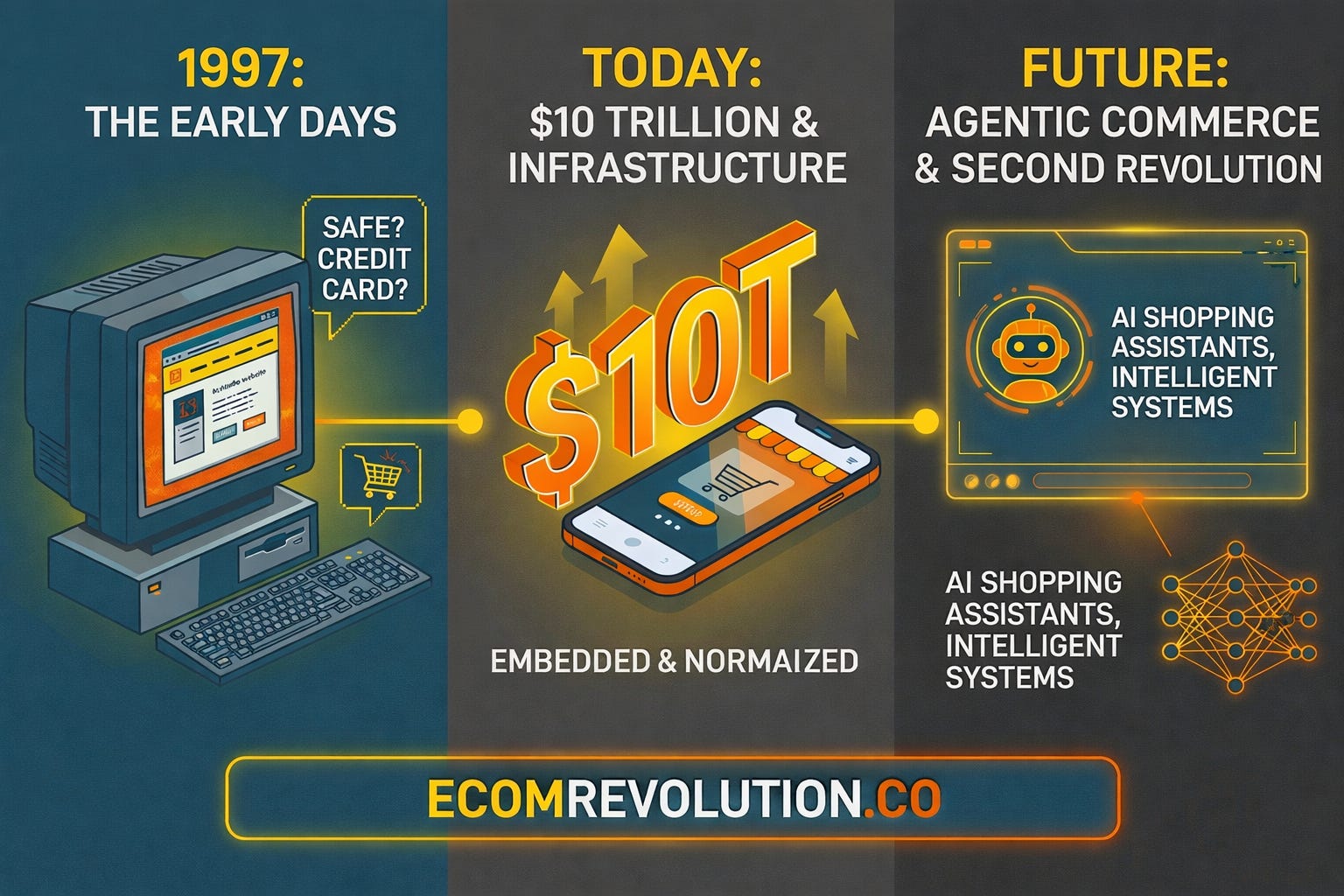
I started in ecommerce in 1997.
We were building ugly storefronts, explaining to customers why entering a credit card online was safe, and praying the checkout didn’t crash when three people showed up at once. There were no real platforms, no playbooks, and definitely no guarantees this whole “buy online” thing would stick.
Now ecommerce has crossed the $10 trillion mark in cumulative U.S. sales.
That number is massive. But what hits me more is the journey behind it.
We watched the birth of an industry.
Then the gold rush.
Then the normalization.
And now we’re entering something else entirely.
This is the era where ecommerce stops being a channel and becomes infrastructure. It’s embedded into how people discover, evaluate, and buy everything.
Inside my community, The Ecommerce Revolution, I see it every week. Founders are no longer asking “Should I sell online?” They’re asking:
How do I compete when everyone is online?
How do I build systems instead of campaigns?
How do I win when growth is no longer automatic?
The next frontier is already forming.
Agentic Commerce.
AI shopping assistants.
Machines helping customers research, compare, and buy without ever touching a traditional storefront.
Five years from now, that $10 trillion number is going to look small. Not because ecommerce explodes in the same way it did before, but because the definition of ecommerce expands. Transactions will happen inside conversations, inside agents, inside ecosystems we’re just starting to understand.
We’re not just watching an industry grow anymore.
We’re in a second revolution.
One that’s less visible, more technical, and far more powerful.
The first wave was about getting online.
The second was about scaling traffic.
The next is about building intelligent commerce systems that operate with you.
The people who treat this shift seriously will build the next generation of category leaders.
The rest will wonder when things got so hard.
Long live ecommerce!
Ramin